
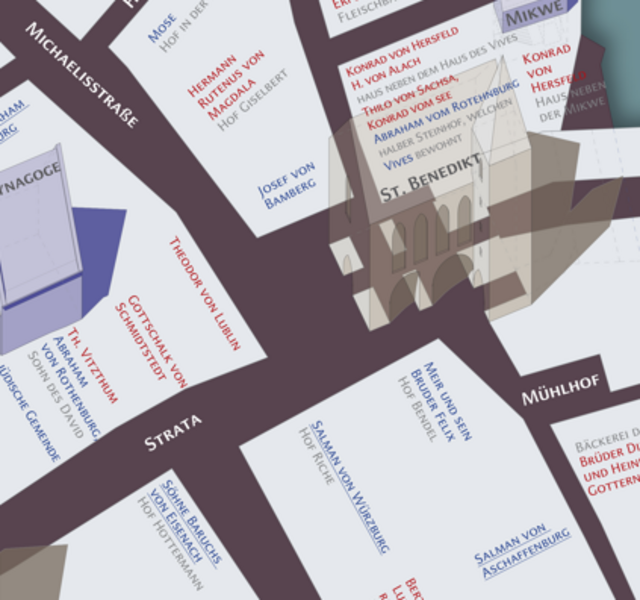
Jews (blue) and Christians (red) lived side by side, in 1293
St Benedicts square
Station 15
Since the High Middle Ages, the area around Benediktsplatz (St Benedicts square) has been the heart of Erfurt’s market district, which stretched for over a kilometre. This is where European trade routes from all directions converged.
Around the central river crossing, however, small-scale trade in valuable goods and travellers’ supplies also flourished. Thus, here and in the surrounding alleys, one finds goldsmiths, fur and cloth merchants, as well as cutlers, saddlers, bagmakers, coopers and hatmakers. The Krämerbrücke (Merchants' bridge) has been documented since the 12th century. It served as an important river crossing but was also the street of the grocers who traded in valuable goods: Oriental spices, silk fabrics, gold or dyes. The bridge grocers were Christians bound by guilds – hence there lived never any Jews on the bridge.
However, there is evidence of a significant Jewish presence in the area around Benediktsplatz dating back to the 13th century. They lived side by side with wealthy Christians, often in prominent houses (see nos. 2, 3, 4 and the map table in the Old Synagogue) and stone buildings on corner plots, such as the house 'Zum Römer' on the north-eastern corner of today’s Town Hall.
Yet it was right in this colourful, trade-oriented quarter that St Benedict’s Church stood. For the parish priest, the growing number of Jews in his parish meant dwindling income from the already small congregation. In 1240, the Archbishop of Mainz ruled in favour of the priest, decreeing that the Jews should now also pay parish dues. However, they apparently did not simply accept this ruling. In 1274, the town council brokered a settlement whereby the Jews had to pay a fixed annual levy to the parish priest.
Theatre
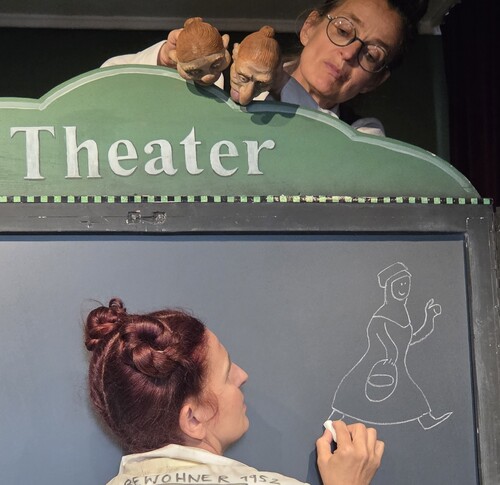
- Come and be enchanted for 15 minutes at the Palim Palim Theatre
- The play "The Mikveh for Beginners" tells the story of Jewish-Christian neighbours
- €5 per person
- For groups of 10 or more, at any time
- or every Thursday at 12.30 pm
PalimPalim - Krämerbrücke 1

