
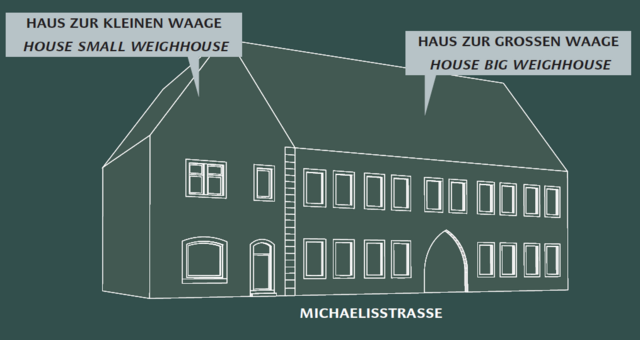
House the big weigh house
Station 9
Abraham’s family probably originated from Rothenburg ob der Tauber. Between 1293 and 1317/27, he was the Jew most frequently mentioned in Erfurt as a moneylender and landowner.
Various documents show him in the immediate circle of the Archbishop of Mainz. This is unique for a Jew. Additionally, over the years he owned six properties in the city centre, including the courtyards with the passageways leading to the synagogue.
He was likely a highly respected figure within the Jewish community, but also amongst the Christian population. His three sons probably left the city during the 1320s.
Following the extermination of the Jewish community on 21 March 1349, organised by sections of the urban elite, the town council seized the Jewish property. The sites were sold to wealthy Christians. Later, Jewish owners reappeared in Michaelisstraße (see no. 11).
One exception was the major building project started by Abraham of Rothenburg, which, due to its size and location, was ideally suited for use as a weigh house and department store by the town council itself.
House the big weigh house
In the 12th and 13th centuries, the properties at Michaelisstraße 6 and 7 formed a single large plot; however, Romanesque architectural elements have survived only on the property at No. 6. Around 1300, the large plot was owned by Abraham of Rothenburg (see nos. 4 and 8). He planned one of the largest residential buildings in medieval Erfurt here. The three-story stone exterior walls were erected, featuring generous windows and facing with ashlars. Basement walls with windows and light niches were built, but the basement was never completed. The construction project was halted no later than the pogrom of 1349, and the shell of the building burned down. After the city council took ownership, the building was completed in a simplified form and, together with the neighbouring building, served as the city’s weigh house and department store for over 350 years.
Various renovations took place in the following centuries; for example, the large pointed-arch courtyard gate facing the Waagegasse alley was added in the 14th or 15th century, and in 1632 the office was fitted with an early Baroque stucco ceiling. In 1712, the municipal weigh house was relocated to the Anger (today’s Angermuseum). The former weigh house on Michaelisstraße was reduced by one story and converted into apartments. In the 18th century, a member of the Electoral Mainz government council, a district administrator, and a judicial councilor lived here. In the 19th century, wholesalers and a printer used the large property. It was renovated and converted between 2014 and 2017.

