

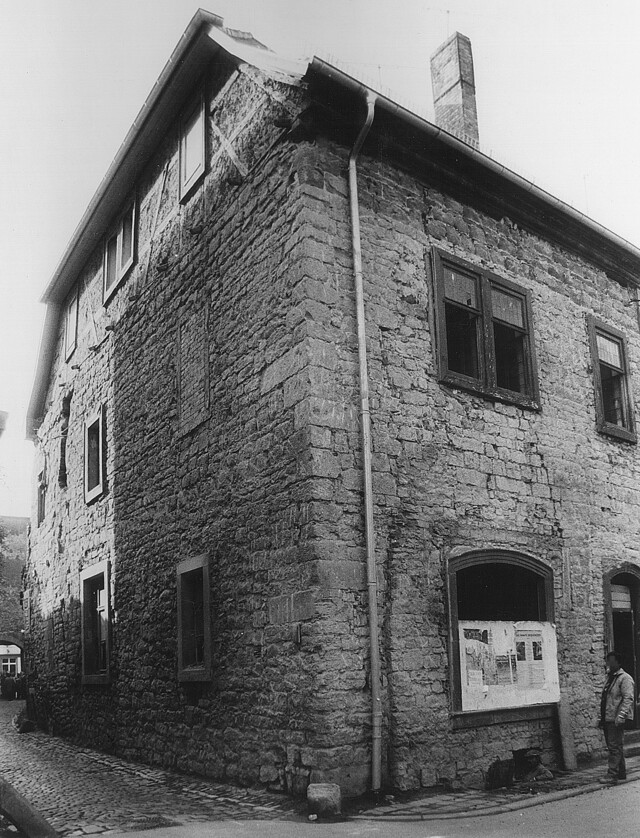
Romanesque masonry of the small weigh house, condition during the renovation in the 1990s
House the small weigh house
Station 8
Around 1100, a two-story stone building with a basement was constructed on this corner lot, as evidenced by the Romanesque window mullion in the façade. In the 13th century, this stone house was extended to the west, forming a large plot together with the neighbouring property. Around 1300, this large plot was owned by the wealthy and respected Jew Abraham of Rothenburg (see nos. 4 and 9). During the pogrom of 1349, the building was partially destroyed. After its restoration and acquisition by the city council, it was used together with the neighbouring building as a municipal weigh house and department store for over 350 years. Several renovations took place in the building between the 15th and 17th centuries. In 1712, the weigh house was moved to the Anger (today’s Angermuseum), and the buildings on St Michael’s street were converted into apartments. In the 18th and 19th centuries, the so-called small weigh house was home to, among others, a doctor, a printer, and a pearl barley merchant. Following its renovation in 1994, the University Library’s restoration workshop was established here in 1996.
Stone with a Yiddish inscription
In the 1990s, during renovation work at the house ‘The small weigh house’, a stone with remains of a Hebrew inscription was discovered. It had likely been built into the wall shortly after 1350, when a door in the cellar was bricked up. The front of the stone shows severe burn marks, which may date from the pogrom of 1349.
The fire also severely damaged the inscription, making it difficult to make out individual letters. However, the legible letters clearly suggest that this is not a genuine Hebrew inscription, but rather a Yiddish inscription written in Hebrew characters. In the Middle Ages, Yiddish was written in Hebrew characters; we have known of the first texts on parchment since the 13th century, whereas inscriptions on stone are very rare. As a building inscription, the Erfurt stone is unique to date. The most likely reading appears to be קלטיר קלר, which means ‘Kalter Keller’ (cold cellar) or ‘Kelter Keller’ (wine press cellar) and could thus refer to the storage or production of beer or wine.
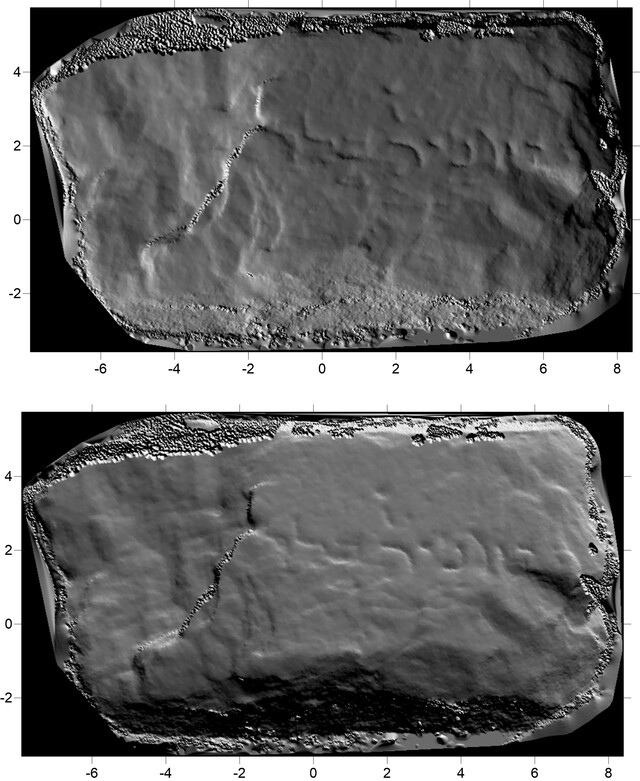
Even with the most advanced 3D scans of the stone, the inscription proved difficult to decipher

