
Old Synagogue
Station 7
The Jewish community of Erfurt becomes tangible in the historical record in the late 11th century, with the earliest recorded building of the Old Synagogue dating from around that time. Up until the 14th century this Jewish place of worship is rebuilt and adapted several times to the needs of the growing religious community. So the construction and usage history of the Synagogue also reflects the history of the Jewish community.
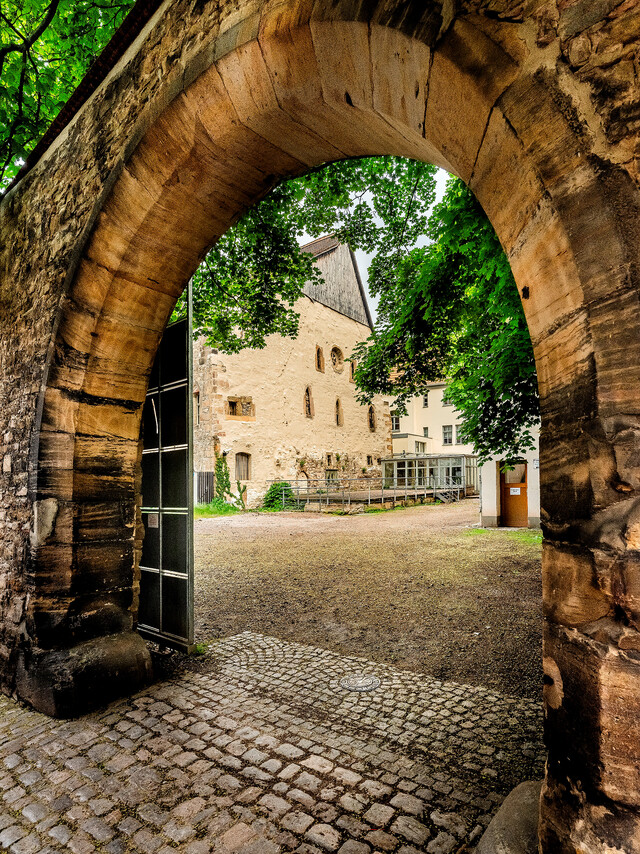
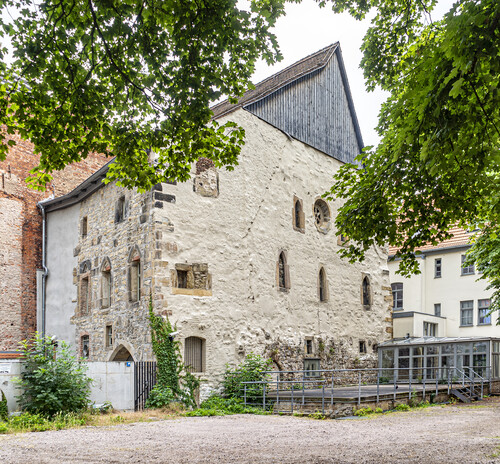
Around 1270 a tall, imposing gabled building came into existence, which still defines the Synagogue’s character today. The show facade in the West with a large rose window can be seen to this day from the neighbouring property. Over centuries Jews and Christians lived side by side in the centre of Erfurt. The year 1349 spelled a sudden end. The plague broke out in Europe in the middle of the 14th century. The Christian population held the Jews responsible for this epidemic. Hence in many places the Jews were persecuted, including Erfurt. On 21 March 1349 rioters descended on the Jewish quarters. They murdered a large number of Jews, the houses around the Synagogue burnt down. The whole community was destroyed, up to 400 people died.
Subsequently to the pogrom the Erfurt Council took the Synagogue into its possession and sold it to a trader. He converted it into a storehouse. In the middle of the 19th century an inn moved into the building: On the upper floor there was a ballroom, on the ground floor a kitchen and dining areas, and a skittle alley in the cellar. Several extensions enclosed the synagogue building almost completely, its original purpose faded from public consciousness. That explains why in 1938 the National Socialists burnt down the actively used Great Synagogue, but not the Old Synagogue.
Rediscovered at the end of the 1980s, studied, and renovated, it has been used as a museum since 2009. The exhibits tell of the heyday of Jewish life and are at the same time an important part of Erfurt’s town history.
short Videoclip
Old Synagogue
UNESCO World Heritage Site
- History
- Visitor information
- Virtual tour
- News

