
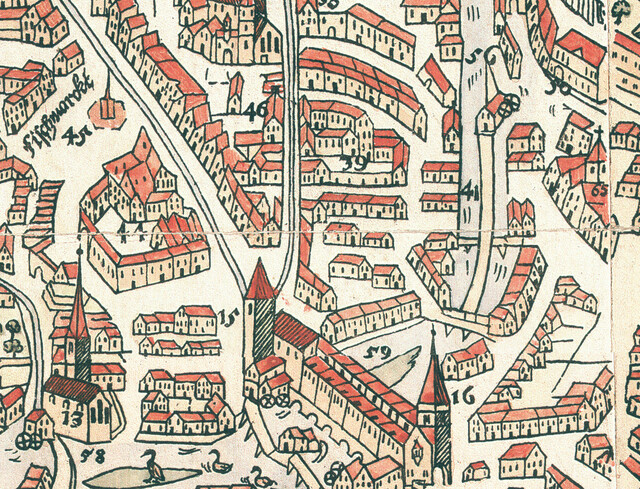
Although the high alley was built over in the 14th century, it is still shown on the so-called Dedekind Plan of 1675 (No. 39)
The high alley
Station 6
To your right, where the modern shop front now stands, there used to be an alleyway – known as the ‚Hoher Weg‘ (High alley) – until the late Middle Ages. It was the shortest route between the synagogue and the mikveh, but also led to the area around the ford that gave the town its name.
It is particularly noteworthy that Romanesque stone buildings dating from the 12th century can be identified at all four corners of the slightly offset junction of Waagegasse, Hoher Weg and Michaelisstraße. This demonstrates the great appeal of the area around the synagogue to merchants and other members of the upper classes in the city’s early days. The fact that Jews were also among those that were engaged in trade is suggested by the sales vaults of a stone extension to the House ‚Zum Greifenstein‘ (now no. 46) dating from around 1300, when Salib and Seligkind lived in this house. Up until the pogrom of 1349, there is evidence of a Jew living here with the telling name ‘Meir am Hohen Weg’ (Meir from the high alley) – a sign of pride and the prominence of the place.
As early as 1300, the wide alley, which had been passable by carriages, had been transformed into a narrow pedestrian alley by the construction of a house, though it still provided access to the mikveh. Presumably after the pogrom, but certainly in the 14th century, the alley was finally closed off by a new building on Michaelisstraße featuring two shop vaults.

